Markets Rattled, Consumer Sentiment Plunges—While Trump Plays Emperor
YouTube · t7ZqHzKDCLw
Quick Read
Summary
Takeaways
- ❖BlackRock's President believes markets are significantly underpricing war risk, with oil potentially spiking to $150/barrel.
- ❖The Trump administration reportedly wargamed $200/barrel oil prices, but only mid-war, not pre-conflict.
- ❖Consumer sentiment has plummeted, with expectations of worsening business conditions short and long-term.
- ❖Inflation expectations are high, with consumers anticipating 4.5% short-run inflation and markets betting on over 5% for the next 12 months.
- ❖Rising energy prices divert consumer spending ($400 million/day extra on gas), increasing recession risk.
- ❖The job market shows fragility, with zero net job growth in the last 6 months and a high share of long-term unemployed.
- ❖The housing market is 'frozen in amber' due to high interest rates and consumer spookedness.
- ❖The Fed faces a dilemma: cut rates to stimulate or raise them to combat inflation, with political pressure complicating decisions.
- ❖The petrodollar system, which underpins US debt financing, faces a long-term threat from de-dollarization, potentially accelerated by geopolitical shifts.
- ❖A 'multi-crisis' scenario is possible from compounding, distinct risks: an AI investment bubble, unregulated private credit markets, and geopolitical events like a Taiwan conflict.
Insights
1Markets Underprice War Risk & Oil Price Spikes
Rob Capido, President of BlackRock, stated that markets are significantly underpricing war risk, predicting oil could spike to $150 a barrel even if the war ended immediately due to disrupted supply chains and infrastructure damage. The Trump administration has reportedly wargamed scenarios of $200 a barrel oil.
BlackRock President Rob Capido's quote in Bloomberg; Trump administration wargaming $200/barrel oil.
2Plunging Consumer Sentiment and Soaring Inflation Expectations
Consumer confidence numbers show worsening expectations for business conditions in both the short and long run. Short-run inflation expectations are at 4.5%, while market participants are betting on overall US inflation exceeding 5% over the next 12 months, significantly above the Fed's 2% target.
Consumer confidence numbers; OECD forecast of 4.2% inflation in the US over 2026; Bloomberg chart showing investors betting on 5%+ inflation.
3Recession Risk from Diverted Consumer Spending and Fragile Job Market
High energy prices lead to higher consumer prices across the supply chain and increase recession risk. American consumers are collectively spending an additional $400 million per day on gasoline, diverting funds from other goods and services, which can lead to companies pulling back, layoffs, and a vicious cycle of recession. The job market also shows fragility with zero net job growth in the last six months and an unusually high share of long-term unemployed.
Consumers spending $400 million more per day on gasoline; Fed Chair Jay Powell's statement on zero net job growth in the last 6 months.
4Housing Market Freeze and Fed's Rate Dilemma
The housing market is 'frozen in amber' with neither buyers nor sellers active, largely due to high interest rates. Higher inflation expectations make it more likely the Fed will maintain or raise rates, impacting mortgage rates. The Fed is caught between combating inflation and stimulating an economy showing signs of fragility, with political pressure from figures like Trump to cut rates further complicating their decisions.
Observation of housing market behavior; connection between inflation, Fed rates, and mortgage rates; Trump's explicit demands for Fed rate cuts.
5Threats to the Petrodollar System and De-dollarization
The petrodollar system, established in the 1970s, requires all oil transactions to be settled in US dollars, making the dollar the world's reserve currency and keeping US debt cheap. A potential demand from Iran for oil transactions in Chinese Yuan as part of a ceasefire could create a 'petro-yuan' competitor, accelerating de-dollarization and having enormous long-term consequences for US debt financing and the American economy.
Historical context of the petrodollar agreement; JVL's hypothetical scenario of Iran demanding Yuan for oil transactions.
Bottom Line
The current economic environment presents a 'multi-crisis' potential where distinct, unrelated 'ticking time bombs' could compound each other, leading to a global depression.
This isn't just about one economic shock; it's about the simultaneous fragility across several sectors. A collapse in one area could trigger a cascade, making recovery far more difficult than if issues were isolated.
Understanding these interconnected risks allows for proactive risk management and diversification strategies, both for individual investors and policymakers, to build resilience against a compounding downturn.
The 'ticking time bombs' include an AI investment bubble, unregulated private credit markets, and geopolitical risks like a potential conflict over Taiwan affecting semiconductor supply.
The AI bubble, fueled by 'bad money chasing good,' could collapse, pulling down significant investment. Unregulated private credit markets hide 'phantom debt' that could trigger broader financial instability. A Taiwan conflict would severely disrupt global semiconductor supply, impacting nearly all electronic goods.
Investors can scrutinize AI-related investments for fundamental value, avoid highly leveraged private credit, and consider supply chain resilience in their business models, particularly regarding critical components like semiconductors.
The US dollar's status as the global reserve currency, while currently benefiting from a 'flight to quality' during global instability, is fundamentally threatened by a perceived lack of rule of law and political instability in the US.
While the dollar temporarily strengthens, the underlying trust in US institutions is eroding. This long-term erosion could eventually lead to a more attractive alternative currency emerging, fundamentally altering global finance and making US debt more expensive to finance.
Policymakers must prioritize restoring institutional integrity and predictability to safeguard the dollar's long-term dominance. Businesses and individuals should monitor global currency trends and consider hedging strategies against potential shifts in reserve currency status.
Key Concepts
Self-Fulfilling Prophecy (Inflation)
If everyone assumes suppliers will raise prices, they preemptively raise their own prices, leading to actual inflation, even if initial shocks were temporary. This 'unanchoring' of inflation expectations is a major Fed concern.
Greater Fool Theory
Market participants might 'pile in' on market manipulation (e.g., Trump's jawboning) not because they believe the underlying claims, but because they expect others to believe it, allowing them to make short-term gains before the reality catches up.
Lessons
- Recognize that market sentiment may be overly optimistic; prepare for continued economic volatility and potential downturns due to underpriced geopolitical risks.
- Factor in high and persistent inflation when making financial plans, as consumer and market expectations suggest prices will remain elevated.
- Understand the interconnectedness of global economic risks, including the AI investment bubble, private credit markets, and geopolitical flashpoints, to better assess overall systemic fragility.
Notable Moments
Discussion of Trump's proposed signature on US currency and face on commemorative coins.
This symbolic action, framed as 'Banana Republic' behavior, underscores a deeper concern about authoritarian tendencies and the erosion of democratic norms. It highlights the importance of symbolic acts in conveying submission to the populace and sending a signal to future aspiring authoritarians that such marks will be removed.
Quotes
"I think the markets are way underpricing the war risk."
"If everybody assumes that their suppliers are going to raise prices... they may preemptively raise prices. So, it's like if you worry about high prices, it can become a self-fulfilling prophecy."
"It's like at the beginning of a Hallmark movie where the heroine is dating the shitty guy, the shitty boyfriend in New York City and she knows she can do better but she hasn't found anything better. So, she just sticks with him."
"If we get a Democratic president... it is imperative that they tear down the ballroom and simply rebuild the East Wing exactly as it was. It doesn't matter what it costs because the message to aspiring authoritarians has to be you can do what you want, but there is no throne. Whatever you do, we will tear down and put it back the way it was. You don't get to leave your mark."
Q&A
Recent Questions
Related Episodes

Trump’s Iran War Could Send Prices Soaring (w/ Kenneth Rogoff) | How to Fix It
"Harvard Professor Kenneth Rogoff details how escalating US debt, attacks on Federal Reserve independence, and geopolitical instability in the Middle East threaten the dollar's global reserve status and could trigger a domestic economic crisis."

BREAKING: War Back On! Ships Bombed! Strait of Hormuz Closed Again!
"The Strait of Hormuz has closed again after Iran bombed two ships, with the host arguing this is a direct consequence of Trump's alleged lies about a peace deal and broader US foreign policy subservience to Israel."

BREAKING: UMICH Consumer Sentiment Hits Lowest Point EVER | Receipts LIVE
"Despite official optimism, consumer sentiment has plummeted to record lows due to surging energy prices, geopolitical instability, and concerns over market manipulation, signaling deep underlying economic uncertainty."
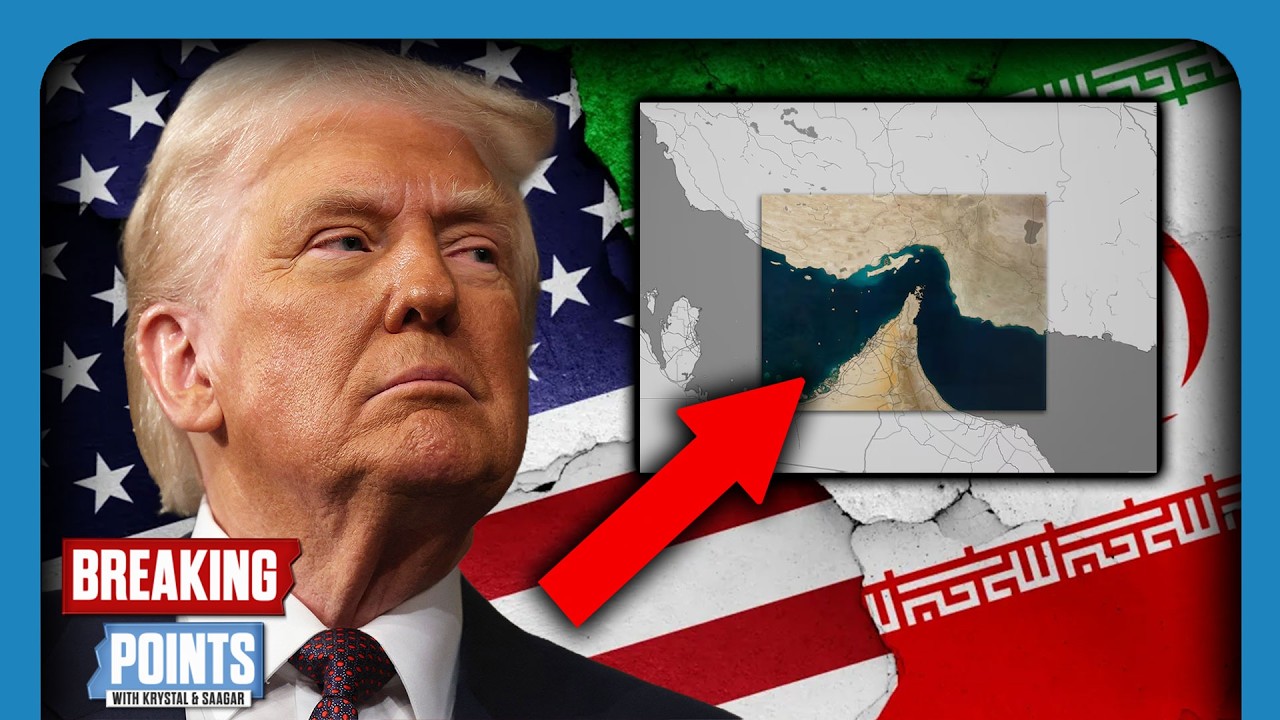
'GET YOUR OWN OIL': Trump Floats Total Surrender
"Donald Trump's declared intent to withdraw from the Iran conflict, leaving the Strait of Hormuz under Iranian control, is framed by hosts as a 'total surrender' with profound global economic and geopolitical consequences."