
BREAKING: Mockler Media Responds to IRAN NEWS
YouTube · xC4DZkow2lY
Quick Read
Summary
Takeaways
- ❖Three US service members died and five were injured due to Donald Trump's strikes on Iran, escalating regional conflict.
- ❖Trump is accused of illegally starting wars and striking countries without congressional approval, violating Article 1 Section 8 Clause 11 of the Constitution.
- ❖In January, Trump 'rugpulled' Iranian protesters, encouraging them with promises of US protection, then doing nothing as the regime killed an estimated 37,000-38,000 people.
- ❖A Reuters/Ipsos poll shows only 27% of Americans approve of the strikes, lower than Trump's typical approval floor.
- ❖Trump's foreign policy is characterized as a 'fraud,' abandoning 'America First' principles for neoconservative interventionism, bombing eight countries in one year.
- ❖The hosts argue that Trump's actions are an attempt to 'save face' and 'look strong' after his previous failures and embarrassments regarding Iran.
- ❖Regime change in Iran would be a larger, more complex undertaking than the Iraq War, risking prolonged occupation, civil war, and increased terrorism.
- ❖The US is seen as being 'dragged into' a perpetual striking cycle by Israel's regional objectives.
- ❖There is a growing 'MAGA schism' with figures like Marjorie Taylor Green, Tucker Carlson, and JD Vance expressing opposition to the Iran strikes, contrasting with Trump's alignment with Marco Rubio.
Insights
1Trump's 'Rugpull' on Iranian Protesters
Donald Trump is accused of betraying Iranian protesters by encouraging mass demonstrations against their government with promises of US support, only to abandon them when the regime violently suppressed the protests, killing an estimated 37,000-38,000 people. This is seen as a 'despicable' act that undermined the Iranian people's struggle.
Trump's tweets from early January, including one on January 2nd, stating, 'If Iran shoots and violently kills peaceful protesters... the United States of America will come to their rescue. We are locked and loaded and ready to go.' He later doubled down, saying, 'America is sending help. Help is on the way.' The guest's family in Iran personally knew five people killed during these protests.
2Illegality and Unconstitutionality of US Strikes
The US strikes on Iran are deemed flagrantly illegal and unconstitutional because Congress, not the President, holds the power to declare war (Article 1 Section 8 Clause 11). The War Powers Act allows presidential deployment only if US troops or civilians were attacked, or if Congress authorized it, neither of which applied to the Iran strikes.
Micah Iran, a law student, cites Article 1 Section 8 Clause 11 of the Constitution and explains the limitations of the War Powers Act. Senator Mark Warner confirmed no intelligence indicated Iran was on the verge of launching preemptive strikes, contradicting administration claims.
3Trump's 'America First' Foreign Policy as a Fraud
Trump's campaign promises of 'America First,' ending 'endless wars,' and focusing on domestic issues are characterized as a 'fraud.' His administration has initiated multiple military interventions, bombed eight countries in one year, and continued to prioritize foreign conflicts, particularly Israel's agenda, at the cost of American lives and resources.
Trump's record of starting seven interventions and bombing eight countries since taking office is cited. The death of three US service members directly contradicts his promise of no US service members dying in foreign wars. The hosts point to $8 billion spent on funding Israel in one year.
4The Dangers and Ineffectiveness of Regime Change in Iran
Attempting regime change in Iran would be catastrophic, far exceeding the scale and complexity of the Iraq War. Iran's population is twice that of Iraq, its size four times, and its regime is deeply institutionalized, not a personality cult. Such an intervention would require a massive, prolonged ground occupation, leading to immense casualties, civil war, and increased terrorism from Iran-backed groups.
Micah Iran details Iran's population (90 million) and size, contrasting it with Iraq. He explains the institutional depth of the Iranian regime, the potential for ethnic balkanization, and the historical failures of US interventions in Iraq, Libya, and Afghanistan, which resulted in power vacuums, civil wars, and open-air slave markets.
5The 'Bush to MAGA to Bush' Foreign Policy Loop
US foreign policy has cycled from the Bush era's pretext of WMDs for Middle East invasion, through Trump's 'America First' non-interventionist rhetoric, only to revert back to Bush-era interventionism with similar pretexts (e.g., preemptive strikes, WMDs) for engaging in the Middle East.
Scott Jennings, a 'literal Bush appointee,' is quoted using 'weapons of mass destruction' as a justification for the Iran strikes, mirroring the Iraq War narrative. Trump's shift from abandoning Ukraine and Taiwan to striking Venezuela, then Iran, is presented as evidence of this policy loop.
Bottom Line
One potential US/Israeli strategy to destabilize Iran, if a full ground invasion is avoided, involves arming and supporting ethnic minorities within Iran (Kurds, Arabs, Turkmans, Azeris) to incite rebellions.
This approach could lead to the 'balkanization' of Iran and a prolonged civil war, potentially destroying the country as a unified nation. While the current regime is seen as bad, this outcome could be even worse for the Iranian people, creating widespread chaos and humanitarian disaster.
Policymakers and analysts should consider the long-term destabilizing effects of supporting internal ethnic conflicts as a foreign policy tool, drawing lessons from similar interventions that led to protracted civil wars and failed states.
Lessons
- Scrutinize political rhetoric on foreign policy, especially claims of 'America First' or non-interventionism, by comparing them against actual military actions and their consequences.
- Understand the constitutional limits of presidential power regarding war declarations and hold elected officials accountable for adhering to these principles.
- Educate yourself on the historical context and outcomes of US military interventions and regime change efforts to critically evaluate current foreign policy decisions and their potential ramifications.
- Support political figures like Ro Khanna who actively push for War Powers Resolution Acts and challenge executive overreach in military actions.
- Recognize that 'decapitation strikes' or targeted killings of leaders often fail to achieve long-term stability and can lead to power vacuums and increased chaos.
Notable Moments
Micah Iran shares his family's personal history of fleeing Iran after the 1979 revolution, including his grandfather's imprisonment and his aunt's beating for a minor religious infraction.
This personal narrative provides a powerful, emotional context for the discussion, highlighting the severe oppression under the Iranian regime and grounding the policy analysis in lived experience.
The hosts highlight an internal 'MAGA schism' regarding the Iran strikes, citing Marjorie Taylor Green's public condemnation of Laura Loomer's pro-war stance and JD Vance's silence, contrasting with Trump's praise for Marco Rubio.
This reveals a fracturing within the Republican base on foreign policy, indicating that Trump's actions are not universally supported even by his allies, which could have significant political implications for future elections.
Senator Ruben Gallego's emotional reaction to the death of US service members, emphasizing the lack of leadership and explanation from the President regarding the national interest of the war.
Gallego's perspective as a veteran and a mother's son underscores the profound human cost of military interventions and the critical need for transparent, justified leadership in wartime.
Quotes
"If Iran shoots and violently kills peaceful protesters, which is their custom, the United States of America will come to their rescue. We are locked and loaded and ready to go. Thank you for your attention to this matter."
"It was flagrantly illegal and unconstitutional. And really the only way to enforce these kind of constitutional provisions is for Congress to step up and impeach the president."
"America first was a farce. I mean, they've spoken big game since like 2013, 2012. Trump's been talking about how we need to put Americans first. How no US service member should be dying in these foreign wars... Now they're in power and they're just neocons all over again."
"Our interest, I think, very much is in not going to war with Iran, right? It would be huge distraction of resources. It would be massively expensive to our country."
"The easy part is the taking out of the leader. That's not the hard part. That's not the challenging part to kill your America. It's extremely America. How many times have we taken out a leader and then clapped for the next few days to weeks? The hard part is a long-term nation building mission..."
Q&A
Recent Questions
Related Episodes

Will Venezuela Be Trump's Vietnam?
"An expert breaks down three perilous pathways for Venezuela under potential US intervention, from a 'Panamanian model' to a 'Libyan-style civil war,' and the broader geopolitical fallout for Latin America."
BREAKING: Protests ERUPT In Iran Over IRGC Surrendering To Trump - Infighting Clashes In Tehran
"Iran is experiencing severe internal infighting and protests as hardline IRGC elements clash with government figures over a perceived 'surrender' to the US, while mainstream Western media misrepresents the situation."
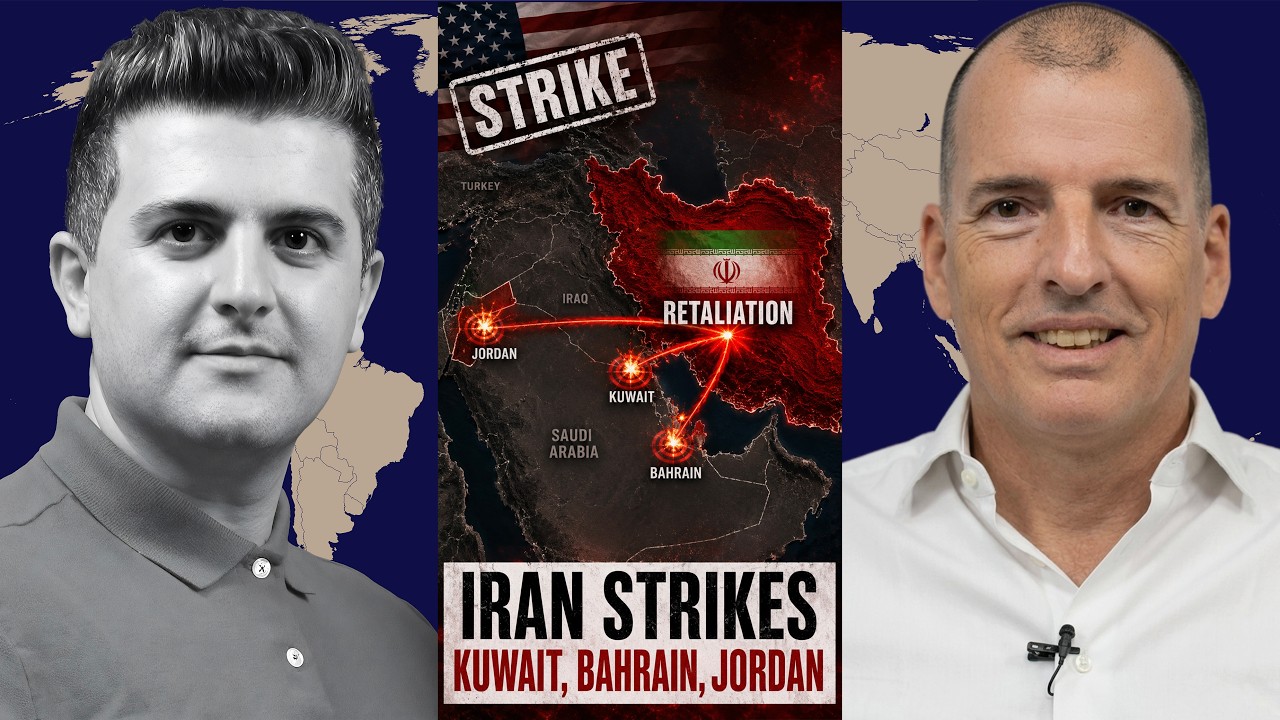
Alex Krainer: US STRIKES Iran – Iran RETALIATES Against Kuwait, Bahrain & Jordan!
"Amidst escalating US-Iran conflict and Iranian retaliation against regional US allies, this episode argues that US foreign policy is deeply controlled by an 'Anglo-Zionist conspiracy' led by the Rothschild banking dynasty, prioritizing Israeli interests over American ones."

Patrick Henningsen: Hezbollah JUST Fired Back at Israel - Iran Vows to “Crush” All Attacks
"Patrick Henningsen argues that the US and Israel initiated an illegal war against Iran, driven by Trump's incompetence and Israeli influence, leading to an inevitable escalation with severe global economic repercussions."