Zero Point Energy, New Phases of Matter and the Weight of the Universe | Cosmic Queries #108
YouTube · yAQj49Wx0F4
Quick Read
Summary
Takeaways
- ❖Cold is the absence of heat; all objects radiate photons, even in 'dark' rooms, with colder objects emitting longer wavelengths like microwaves (CMB).
- ❖Newton's Law of Cooling states that temperature change rate is proportional to the temperature difference between objects and their environment.
- ❖The universe's total mass can be estimated by scaling known stellar and galactic masses, then multiplying by six to account for dark matter.
Insights
1Zero-Point Energy and the Impossibility of Absolute Zero
Absolute zero is impossible to reach because quantum fluctuations prevent particles from ever completely stopping their motion. This residual energy, known as zero-point energy, is the lowest possible energy state, and energy cannot be extracted from it because there is no lower energy state for it to transition into, thus upholding the laws of thermodynamics.
Quantum physics dictates that particles always have some motion, even at the lowest possible temperatures, preventing a truly stationary state.
2The Ubiquity of Photons and the Cosmic Microwave Background
Photons are literally everywhere, constantly radiating from any object with a temperature above absolute zero. The type of light emitted depends on temperature; humans emit infrared, while objects at 3 Kelvin (like the universe's background) emit microwaves. The cosmic microwave background (CMB) is composed of these ancient microwaves, remnants from the Big Bang, confirming that even seemingly 'dark' space is filled with radiation.
All objects at any temperature radiate photons. The CMB is 3 degrees Kelvin, emitting microwaves.
3Newton's Law of Cooling
Isaac Newton's law of cooling describes how the rate of temperature change between two objects or an object and its environment is directly proportional to their temperature difference. A larger temperature difference results in a faster rate of heat transfer until equilibrium is reached.
The bigger the temperature difference, the faster the rate of change of temperature will be.
4Gravity as Spacetime Curvature, Not Necessarily a Force
Gravity is understood as the curvature of spacetime caused by mass and energy, which dictates how objects move. This perspective challenges the assumption that gravity must have a force-carrying particle (like the hypothetical graviton), suggesting it might exist outside the quantum paradigms that define other fundamental forces.
The assumption that gravitation has a force-carrying particle (graviton) is an attempt to represent classical gravity with quantum physics. However, if gravity is just the curvature of space and time, it might not be a 'force' in the traditional sense.
5Optimal Design for a Next-Generation Telescope Array
An ideal next-generation telescope array would be placed on the far side of the Moon. This location offers a vacuum (no atmosphere), shielding from Earth's radio noise, and the ability to deploy telescopes across all electromagnetic spectrums. The ultimate goal is to detect non-electromagnetic phenomena like gravitational waves and neutrinos.
Placing an array of telescopes on the far side of the moon, covering all bandwidths, would avoid atmospheric interference and Earth's radio noise. The next generation should detect gravitational waves and neutrinos.
6The Measurable Weight of the Observable Universe
The weight of the observable universe can be estimated by multiplying the known mass of the Sun by the number of stars in a galaxy, then by the number of galaxies in the observable universe. This initial calculation is then multiplied by a factor of six to account for the presence of dark matter, which exerts gravitational influence but is not directly visible.
Calculated by multiplying the mass of the Sun (2 x 10^33 grams) by 100 billion stars, then by a trillion galaxies, and finally by six to account for dark matter.
Bottom Line
The non-extractable nature of zero-point energy fundamentally limits the concept of 'free energy' from quantum vacuum fluctuations, challenging many speculative sci-fi energy sources.
This means that while the universe is teeming with quantum energy, our current understanding of physics suggests it cannot be harnessed for practical, infinite energy generation.
Focus research on more viable energy sources like solar or geothermal, or explore theoretical breakthroughs that might redefine energy extraction from quantum fields without violating thermodynamics.
The proposal for space-based solar arrays orbiting Earth, beaming energy via microwaves, offers a solution for continuous, cloud-unimpeded solar power.
This could provide a constant, abundant energy source, overcoming terrestrial limitations like night and weather, potentially ending energy-related conflicts.
Invest in the engineering and safety protocols for orbital solar arrays and microwave energy transmission, addressing concerns about beam safety and orbital debris.
Iceland's use of geothermal energy to heat water under city streets prevents snow accumulation, eliminating the need for plows, salt, and accident reports.
This demonstrates a highly efficient and sustainable urban infrastructure model that significantly reduces maintenance costs and improves safety in cold climates.
Cities in snowy regions could explore adopting similar geothermal heating systems for public infrastructure, requiring significant initial investment but offering long-term operational savings and environmental benefits.
Opportunities
Orbital Solar Power Stations with Microwave Transmission
Develop and deploy large solar arrays in Earth orbit to capture continuous sunlight, then beam the energy down to terrestrial receivers via microwaves. This overcomes atmospheric interference and diurnal cycles, providing 24/7 clean energy.
Geothermal City Infrastructure Heating
Implement city-wide geothermal heating systems that circulate hot water under roads, sidewalks, and public spaces to prevent snow and ice accumulation. This eliminates the need for snow removal, road salt, and reduces winter-related accidents.
Key Concepts
Absence of Heat
Cold is not a substance or energy that can be added; it is simply the absence or removal of heat. This principle explains how refrigerators work by pulling heat out of food and how spacecraft struggle to dissipate heat in a vacuum.
Virialization
In astrophysics, a 'virialized' cluster (e.g., of galaxies) is one that has reached a mature, stable shape where energy is shared and distributed, leading to a spherical envelope. 'Ratty' clusters are not yet virialized, indicating ongoing dynamic processes.
Lessons
- Reframe your understanding of 'cold' not as a distinct entity, but as the absence of heat, which can clarify how temperature changes and energy transfers occur.
- When considering fundamental forces, ponder whether gravity truly fits the 'force' paradigm or if its description as spacetime curvature offers a more complete, albeit less intuitive, understanding.
- Appreciate the constant presence of photons, even in seemingly dark environments, and recognize that our visual perception is only a small fraction of the electromagnetic spectrum that fills the universe.
Designing a Next-Generation Cosmic Observatory
Select the far side of the Moon as the primary location to eliminate atmospheric interference and Earth-based radio noise.
Integrate a comprehensive array of telescopes capable of observing across the entire electromagnetic spectrum (radio, infrared, visible, UV, X-ray, gamma-ray).
Develop and deploy advanced detectors specifically designed to observe non-electromagnetic phenomena, such as gravitational waves and neutrinos, to open new windows into the universe.
Notable Moments
Neil deGrasse Tyson recounts his early experiences with astronomy, starting with binoculars and his first 2.4-inch refracting telescope at age 11. He describes observing Saturn's rings and Jupiter's weather bands, and later acquiring a 6-inch Newtonian reflecting telescope that he took to Africa for a solar eclipse.
This personal narrative highlights the profound impact early exposure to science and hands-on experience can have on shaping a scientific career, demonstrating how curiosity can be ignited and nurtured from a young age.
Tyson shares a story from his youth when neighbors called the police because they saw him on his roof with a telescope. He defused the situation by inviting the officers to look through his telescope at Saturn.
This anecdote humorously illustrates the intersection of science, public perception, and racial bias, showing how scientific curiosity can bridge unexpected divides and transform potentially tense situations into moments of shared wonder.
Quotes
"I'm so fast. I turn off the lights and I'm in bed before the room get dark."
"What we sense as cold is just the absence of heat."
"The energy below which you cannot go, okay, because it's zero point, but it's not really zero, right? But if you try to get to zero, that's what you're stuck with. And that's quantum fluctuations. And you you I don't think you can extract energy out of that lowest energy fluctuation because it needs a to take energy out, you need a lower energy state to land in."
"Matter tells space how to curve. Space tells matter how to move."
"There is six times as much gravity in the universe as is what is created by that mass that I just calculated."
Q&A
Recent Questions
Related Episodes
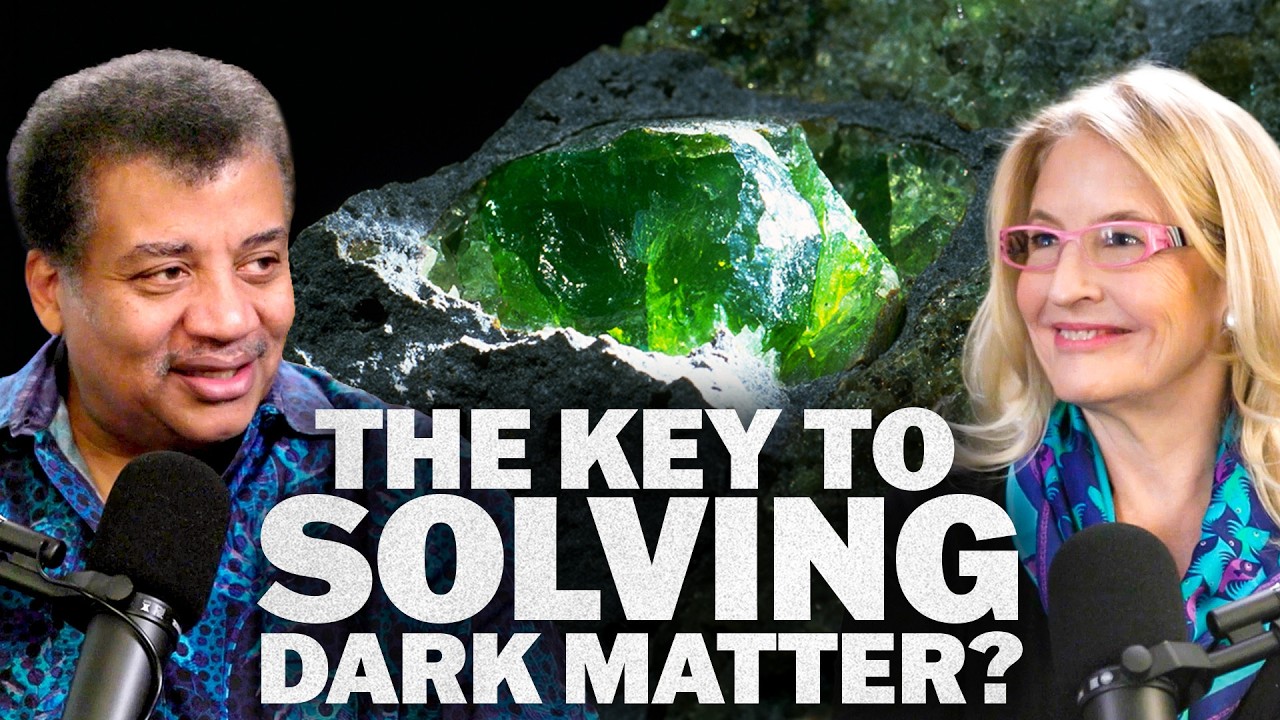
How We’re Trying to Detect Dark Matter Particles, with Katherine Freese
"Theoretical physicist Katherine Freese reveals cutting-edge methods for detecting dark matter, from billion-year-old rocks to 'dark stars' observed by the James Webb Telescope, and challenges prevailing theories on dark energy."
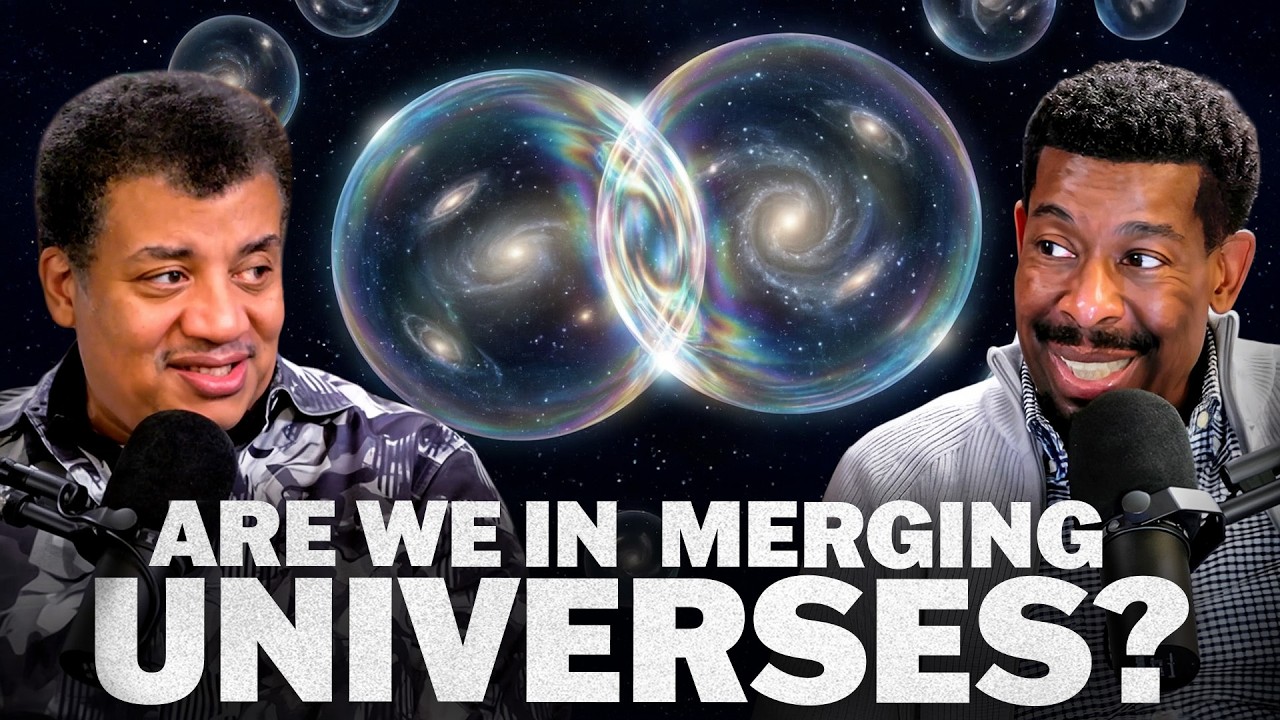
Alcubierre Drives, Antimatter Multiverses & More! | Cosmic Queries #103
"Neil deGrasse Tyson and Chuck Nice tackle listener questions ranging from the feasibility of reviving the sun with nukes to the physics of black holes, warp drives, and the multiverse."

Do Colliding Pulsars Create All of the Universe’s Gold? | Cosmic Queries #112
"Neil deGrasse Tyson and Negin Farsad tackle diverse cosmic questions, from the practicality of space fueling stations and the origins of gold to debunking lunar myths and contemplating the natural evolution of AI."
Mindscape Ask Me Anything, Sean Carroll | June 2026
"Sean Carroll fields a diverse range of listener questions, from the hypothetical Pope Leo XIV's stance on AI to the intricacies of quantum cyclic universes, the philosophy of free will, and the future of science and society."