We Asked A TOP Liberal Zionist How They Can Be PRO-ISRAEL
YouTube · zEMiYspXSoY
Quick Read
Summary
Takeaways
- ❖J Street, founded in 2008 as pro-Israel and pro-peace, has been called a 'cancer on the Jewish community' by the Israeli ambassador for its critical stance.
- ❖The organization now supports ending U.S. financial assistance and withholding offensive weapons from Israel, citing violations of American and international law.
- ❖J Street's 'theory of change' focuses on shifting American politics to enable a more balanced U.S. policy that pushes for a two-state solution, rather than solely focusing on punitive measures.
Insights
1J Street's Evolution on US Aid to Israel
J Street's stance on US aid to Israel has significantly evolved. Initially, the organization pushed for conditioning aid, a position considered radical in 2019. Now, it advocates for phasing out billions in financial assistance and withholding offensive weapons, arguing that Israel is violating American and international laws. This shift reflects a growing frustration with Israel's actions and the U.S.'s 'blank check' policy.
Jeremy Ben-Ami states, 'we have made it our a point over the course of our entire existence to try to push the envelope on these debates and and the discussion of restrictions on arms in the 2019 2020 window that was a first within the Democratic party.' He later clarifies, 'We support ending financial assistance, phasing out the billions of dollars a year rapidly... we shouldn't even be selling them weapons if they're breaking American law.'
2The 'Liberal Zionist' Dilemma and the Two-State Solution
Ben-Ami defines J Street's 'liberal Zionist' position as supporting a national homeland for the Jewish people while also advocating for a Palestinian state with equal rights. He rejects the 'ethno-supremacist' label, arguing that Israel can be both Jewish and democratic if it divides the land and ensures full equality for its Arab citizens. He emphasizes that a two-state solution is the only viable path for both peoples to live together peacefully.
Ben-Ami states, 'I still believe that there's going to have to be a border drawn between a state that is a state for the Palestinian people, a state of Palestine and a and a state that is the state of Israel that provides a national home for the Jewish people.' He adds, 'the only way actually for there to be a state that is Jewish in nature and democratic and provides rights to all of its citizens... is for there to be a division of the land.'
3J Street's 'Theory of Change' in American Politics
J Street believes that the root problem in the Israel-Palestine conflict lies in American politics, which constrains U.S. policy. Their strategy is to intervene politically to shift American discourse and policy, thereby creating pressure for a resolution. Ben-Ami acknowledges the anger and calls for punishment from the Democratic base but emphasizes J Street's focus on building a better future through political solutions.
Ben-Ami explains, 'the theory of change of J Street which is that the politics of this issue are the root problem that the policy is constrained and almost dictated by the politics and so you needed a political intervention in order to shift American politics so that our policy could change.'
Bottom Line
J Street's nuanced stance on defensive weapons: While advocating for withholding offensive weapons from Israel, Ben-Ami supports continuing to provide defensive systems like Iron Dome, believing it prevents an even deeper cycle of violence by protecting Israeli civilians from rockets.
This distinction highlights a key fault line even among critics of Israeli policy, where some prioritize civilian protection in the immediate term, while others argue that even defensive capabilities enable broader aggression by providing immunity.
Policymakers and advocates must carefully consider the downstream effects of military aid, distinguishing between types of weaponry and their strategic implications for both defense and enabling offensive actions.
The host's challenge to 'liberal Zionism': The host argues that the core ideal of maintaining a Jewish majority in Israel inherently leads to 'ethno-supremacist' policies, including 'demographic engineering' and violence, making the 'liberal' and 'Zionist' labels dissonant.
This directly confronts the foundational premise of J Street's ideology, suggesting that the pursuit of a Jewish national home, as currently interpreted and implemented, is incompatible with universal liberal values of equality and human rights, especially given Israel's de facto control 'from the river to the sea.'
This perspective forces a re-evaluation of whether a 'Jewish and democratic' state is truly achievable without fundamentally altering the demographic priorities that have historically driven Israeli policy, or if such a state necessitates a two-state solution to avoid a single, unequal entity.
Key Concepts
Overton Window
J Street positions itself as an organization that pushes the 'Overton window' of acceptable political debate on Israel-Palestine, moving the center of discussion rather than operating at the extreme edges.
Theory of Change
J Street's core belief that changing American politics is necessary to shift U.S. policy towards Israel, which in turn can influence Israeli actions and lead to a resolution of the conflict.
Nixon to China Moment
The idea that a hardline leader, like Menachem Begin making peace with Egypt, can sometimes be the one to achieve significant, unexpected breakthroughs, suggesting that Israel's current right-wing government might eventually be replaced by one capable of compromise.
Lessons
- Analyze the 'Overton window' in political discourse to understand how organizations like J Street strategically push for policy changes by gradually shifting mainstream acceptable opinions.
- When evaluating foreign policy, differentiate between an organization's stated ideals (e.g., 'pro-Israel' as a vision for a better Israel) and the current actions of the government it relates to, recognizing that internal dissent can be a form of advocacy.
- Consider the complex interplay between domestic political pressure (e.g., lobby groups, public opinion) and foreign policy outcomes, particularly in long-standing international conflicts.
Notable Moments
The Israeli ambassador to Washington called J Street a 'cancer on the Jewish community' and accused Jeremy Ben-Ami and Bernie Sanders of being 'fake Jews.'
This extreme condemnation from an official Israeli representative highlights the deep ideological chasm between the current Israeli government and 'liberal Zionist' organizations like J Street, underscoring the intensity of the debate over Israel's identity and actions.
Jeremy Ben-Ami recounts a story about his early vision for J Street, stating he hoped it would succeed quickly so he could 'close down the shop and we'll work on climate change.'
This quote reveals an underlying idealism and perhaps a naive optimism about the ease of resolving the Israeli-Palestinian conflict, contrasting sharply with the enduring complexity and escalation of the situation over the years.
Quotes
"The problem isn't J Street. The problem is a government that would send a man as a diplomat to Washington DC who calls the Jewish critics of the state of Israel cancer. That's that's the problem."
"The only way out of this war, this ongoing hundred-year conflict between Palestinians and Jews is a political resolution of their underlying conflict."
"I believe Israel has the right to exist, not as a Jewish state, as a state with equal rights."
"I am pro-Israel, but I'm anti-occupation. I am anti the moral abomination of what happened in Gaza. I am anti- the settler terrorism that is happening on the West Bank because I'm anti- those things. That's how I define my pro-Israel."
Q&A
Recent Questions
Related Episodes

Iran Deal Skepticism. Whoopi Vs Vance. Potomac Park Invasion. Racist Hurls Slurs At Black Boy.
"This episode dissects multiple instances of alleged anti-Black policies and racial injustice, from the Trump administration's legal challenges to reparations and the Iran deal, to police brutality and the erasure of Black history."

PBS News Hour full episode, June 12, 2026
"The U.S. and Iran inch closer to a contentious peace deal amidst conflicting terms, while President Trump hosts a UFC cage fight on the White House lawn, and Gaza's children struggle for education in war-torn conditions."
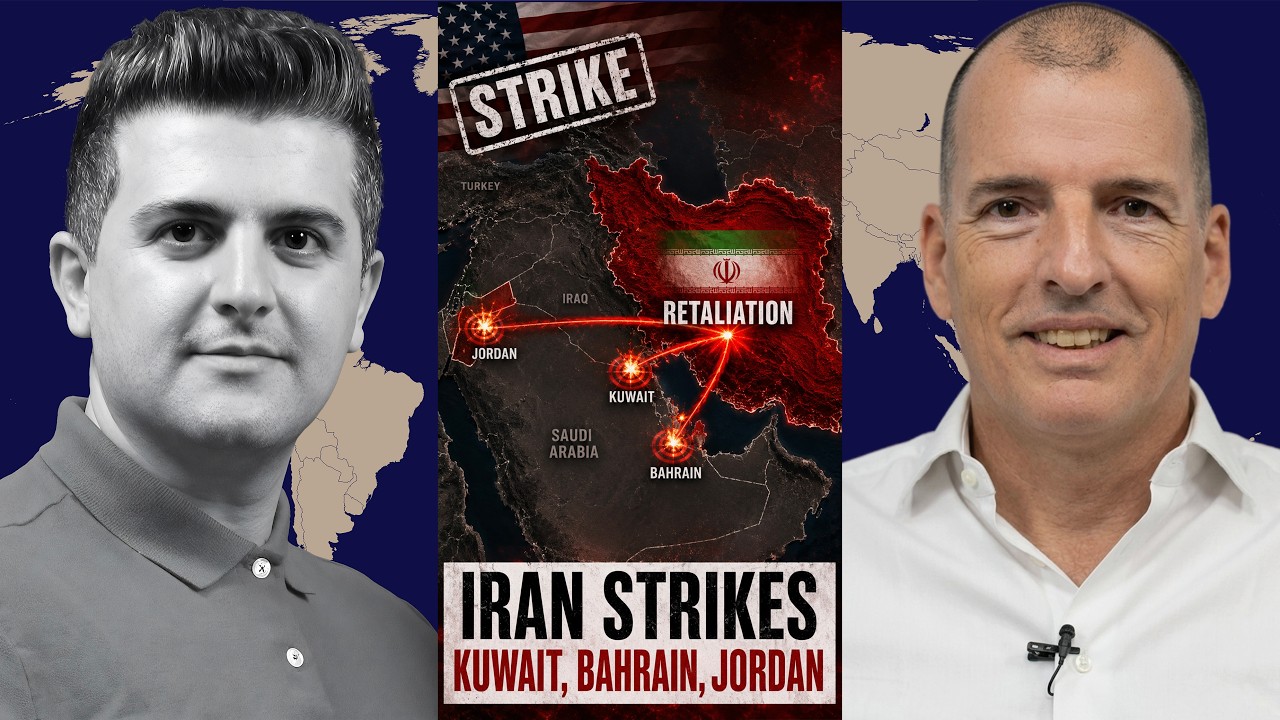
Alex Krainer: US STRIKES Iran – Iran RETALIATES Against Kuwait, Bahrain & Jordan!
"Amidst escalating US-Iran conflict and Iranian retaliation against regional US allies, this episode argues that US foreign policy is deeply controlled by an 'Anglo-Zionist conspiracy' led by the Rothschild banking dynasty, prioritizing Israeli interests over American ones."

Larry Johnson: Iran Missiles Rain Down on Northern Israel – Massive Strikes!
"Geopolitical analyst Larry Johnson details how Israel's recent strike on an 'empty building' in Beirut triggered direct Iranian missile retaliation, escalating regional tensions and jeopardizing a US-Iran peace deal brokered by Pakistan."