
Machine Text Detectors are Membership Inference Attacks
YouTube · 60Suu9eK13o
Quick Read
Summary
Takeaways
- ❖Machine text detection (classifying LLM-generated vs. human text) and membership inference (classifying if text was in a model's training set) have historically been studied as distinct problems, with minimal cross-citation between research communities.
- ❖Both tasks exhibit striking similarities, fundamentally looking for text that a particular language model assigns an unusually high likelihood to.
- ❖Theoretically, the asymptotically optimal method for both machine text detection and membership inference is proven to be the same: a likelihood ratio test.
- ❖Empirically, methods originally designed for machine text detection demonstrate strong competitive performance when applied to membership inference, and vice-versa.
- ❖The relative rankings of different detection and inference methods remain largely consistent across both tasks, indicating high cross-task transferability (Spearman correlation of 0.66).
- ❖High-performing empirical methods, such as Binoculars and Fast DetectGPT, can be viewed as practical approximations of the theoretical likelihood ratio test.
- ❖This transferability extends to blackbox detection settings, where membership inference methods show strong performance in identifying text from models like ChatGPT and GPT-4.
- ❖The historical separation of these fields has led to redundant development of methods with identical underlying metrics (e.g., DetectGPT and Neighborhood Attack, N-gram Coverage Attack and DNPT).
- ❖A unified evaluation suite has been released to promote cross-task collaboration and facilitate the sharing of ideas and methods between these research areas.
Insights
1Theoretical Equivalence of Optimal Methods
The research theoretically proves that the asymptotically optimal method for both machine text detection and membership inference is identical: a likelihood ratio test. This test compares the likelihood of a given text under the target language model to its likelihood under a background 'oracle' distribution of human text. This equivalence holds under specific asymptotic assumptions, such as infinite training data and perfect model convergence.
The Neyman-Pearson Lemma is used to show that the likelihood ratio of the model's distribution over the oracle's distribution achieves optimal accuracy for both tasks. The proof for membership inference simplifies to this same likelihood ratio under the assumption that the text's likelihood is a sufficient statistic for the model.
2Empirical Cross-Task Transferability
Empirical studies demonstrate that methods developed for one task (e.g., machine text detection) perform surprisingly well when directly applied to the other task (membership inference), and vice-versa. The relative performance rankings of methods remain largely consistent across both tasks, indicating a high degree of transferability.
Experiments using diverse methods on MIMU and RAFT benchmarks show that machine text detection methods achieve strong performance on MIA. A Spearman rank correlation of 0.66 was observed between method rankings across the two tasks. This transferability also extends to blackbox detection settings for models like ChatGPT and GPT-4.
3Practical Implications for Research and Development
The historical separation of MTD and MIA research has led to redundant efforts, with distinct papers proposing methods that share identical underlying metrics. Recognizing their fundamental relationship can foster cross-task collaboration, accelerate progress, and lead to more efficient development of robust tools for AI safety, privacy, and copyright infringement detection.
Examples like DetectGPT and Neighborhood Attack, or N-gram Coverage Attack and DNPT, are cited as methods proposed separately but using the same underlying metrics. The Anthropic AI copyright settlement is mentioned as an instance where membership inference work is practically significant. A unified evaluation suite is released to facilitate this collaborative approach.
Bottom Line
The theoretical equivalence between machine text detection and membership inference relies on strong asymptotic assumptions (e.g., a perfect learner model replicating its training data distribution), which do not fully capture the generalization capabilities and semantic influences of real-world large language models.
This highlights a gap between current theoretical understanding and practical LLM behavior. While useful as a mental framework, the direct applicability of the theoretical optimal metric is limited in scenarios where models generalize beyond exact training data replication or where text similarity impacts likelihoods.
Developing new theoretical frameworks that account for LLM generalization, semantic similarity, and the nuanced influence of training data on model outputs could yield more practically relevant insights into detection and inference, bridging the current theoretical-empirical divide.
Despite a common belief in the privacy auditing community that attack strength significantly weakens when moving from whitebox access (model parameters, checkpoints) to blackbox access (generated text, likelihoods), the empirical findings show strong cross-task transferability even in blackbox settings.
This suggests that the 'gap' in attack strength between whitebox and blackbox scenarios might not be as wide or insurmountable as sometimes perceived, especially if leveraging high-performing methods from related tasks. Blackbox methods, though limited, can still provide substantial signal.
Researchers should explore how robust blackbox machine text detection methods can be adapted or combined with existing privacy auditing techniques to improve the effectiveness of membership inference attacks or defenses, even with restricted model access. This could lead to more practical and scalable privacy auditing tools.
Key Concepts
Neyman-Pearson Lemma
This statistical lemma states that for a given binary hypothesis test, the likelihood ratio test is the uniformly most powerful test, meaning it achieves the highest statistical power for a fixed false positive rate. It forms the theoretical basis for proving the optimality and equivalence of the likelihood ratio for both machine text detection and membership inference in asymptotic scenarios.
Lessons
- Researchers in machine text detection and membership inference should actively explore and apply methods from the other domain to accelerate progress and avoid redundant development.
- Utilize the provided unified evaluation suite to easily implement and test new methods across both machine text detection and membership inference tasks, fostering cross-task collaboration.
- When developing new detection or inference methods, consider how they approximate or relate to the theoretical likelihood ratio test, as this metric has proven to be asymptotically optimal and empirically effective.
Unified Evaluation for LLM Detection & Inference
Access the open-source unified evaluation suite provided by the researchers on GitHub.
Implement your new machine text detection or membership inference method within the framework of the suite.
Run your method on both the machine text detection and membership inference benchmarks to assess its cross-task performance and transferability.
Notable Moments
An audience member questions the theoretical equivalence, highlighting that in reality, multiple models exist, and membership inference is typically defined with respect to a specific model, unlike general machine-generated text detection.
This question clarifies the scope of the theoretical proof, emphasizing that it applies to detecting text from a *particular* language model, not a general 'machine-generated' category. It also sets up a later discussion about the practical 'gap' between theoretical assumptions and real-world LLMs.
An audience member expresses surprise at the theoretical result, noting that in practice, there's a significant gap between having access to a model's parameters (whitebox) versus only its generated text (blackbox) for membership inference.
This exchange highlights a core tension between the theoretical findings and practical experience in privacy auditing. It prompts the speakers to elaborate on the strong asymptotic assumptions of their proof and acknowledge that real LLMs introduce complexities not fully captured by the current theory, setting the stage for future research directions.
Quotes
"These two tasks have been studied separately. So we searched the number of papers on both tasks... and we found that very little cross-task citations."
"Our goal is to show that machine text detection and membership inference are fundamentally related to each other."
"Our goal with this proof is not to sort of like discourage you know any work on those other metrics, but instead to to sort of give the beginnings of some sort of theoretical link between the two tasks uh in any capacity."
"The Anthropic settlement for AI copyright infringement was likely predicated... on a lot of this sort of membership inference work done to show that there was in fact training on copyrighted data."
Q&A
Recent Questions
Related Episodes

Atomic Facts to Structured Knowledge: Rethinking Unlearning & Jailbreaking in Large Language Models
"This talk reveals how the interconnected nature of knowledge within Large Language Models creates fundamental vulnerabilities, enabling sophisticated jailbreaking attacks and undermining current unlearning methods."
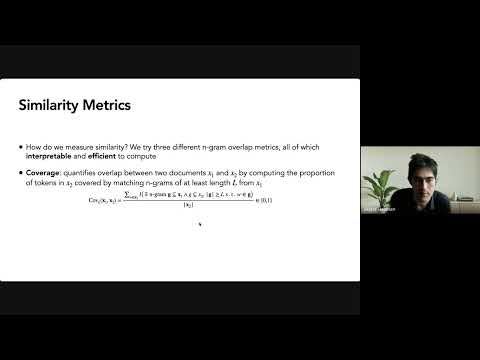
The Surprising Effectiveness of Membership Inference with Simple N-Gram Coverage
"Discover how a simple n-gram coverage attack can surprisingly and effectively detect if specific data was used to train large language models, even with limited black-box access."

Recording Scary FIRST DATE Stories!!!
"Four terrifying first-date stories expose the dark side of modern dating, from stalkers and cheating spouses to drug-spiking and gang violence, revealing critical lessons in vigilance and self-preservation."

5 Papers That Show Where AI Research Is Heading Right Now
"This Y Combinator session explores five cutting-edge AI research papers, revealing advancements in AI for biology, self-play for LLMs, real-time voice agents, formal math verification, and agentic programming workflows."