A blockbuster shakeup to the world order
YouTube · FpKGFVPl6Zo
Quick Read
Summary
Takeaways
- ❖The US military operation to kidnap Venezuelan President Nicholas Maduro was an unprecedented violation of international law and US constitutional authority.
- ❖David Pakman asserts the primary motivation for the abduction was Donald Trump's personal anger and embarrassment over Maduro's public dancing and mockery, not strategic policy goals.
- ❖The operation lacked congressional authorization, violated the UN Charter, and disregarded sovereign immunity for a sitting head of state.
- ❖Purported justifications (narco-trafficking, authoritarianism, oil, regime change) are dismissed by Pakman as inconsistent with Trump's past actions or current realities.
- ❖The host suggests Trump's decision-making reflects cognitive decline, characterized by disinhibition, aggression, and impulsivity.
- ❖The abduction sets a dangerous precedent, potentially inviting similar unilateral actions from powers like Russia (in Ukraine) and China (in Taiwan).
- ❖The Trump administration, including Secretary of State Marco Rubio, demonstrated no clear plan for Venezuela's future post-Maduro's removal.
- ❖Reports from the Wall Street Journal detail Trump's deteriorating health, including ignoring doctors, self-medicating with aspirin, and mistaking a CAT scan for an MRI.
- ❖Trump's foreign policy is characterized by stubbornness, emotional responses, and a dismissal of expert advice, which Pakman argues is terrifying given his access to nuclear codes.
Insights
1Unprecedented Violation of International and Domestic Law
The US military operation to kidnap Nicholas Maduro violated multiple legal frameworks: it lacked congressional authorization (a constitutional requirement for major military force), contravened the UN Charter's prohibition on using force against another state's territorial integrity without Security Council approval, and ignored the principle of sovereign immunity for a sitting head of state. This action bypassed established extradition processes.
Pakman details the lack of congressional authorization (), UN charter violations (), and disregard for sovereign immunity ().
2Personal Vengeance, Not Policy, as Core Motivation
Pakman asserts that the primary driver for the military operation was Donald Trump's personal anger and embarrassment. Reporting from the New York Times indicated Trump was infuriated by Maduro's public dancing and mockery, which he perceived as defiance and disrespect, leading to an impulsive decision to 'call his bluff.'
New York Times reporting cited by Pakman indicates Maduro's dancing and 'no crazy war' phrase triggered Trump (, ). Secretary of Defense Pete Hegseth's 'Maduro effed around and found out' comment is presented as further evidence of this personal motivation ().
3Lack of Strategic Plan and Post-Abduction Chaos
Despite the dramatic abduction, the Trump administration demonstrated no coherent plan for Venezuela's future. The entire regime, including generals and the Vice President, remained in power, contradicting any claims of 'regime change.' American oil companies, initially seen as beneficiaries, expressed disinterest due to Venezuela's dilapidated infrastructure and political instability.
Trump's own words reveal no plan (, ). Marco Rubio's inability to answer who is in charge or when elections would occur (, ) highlights the lack of strategy. Oil companies' disinterest is noted (, ).
4Dangerous Precedent for Global Powers
The unilateral abduction of a foreign leader by the US weakens the international rule of law and sets a perilous precedent. Pakman argues this action could be exploited by other major powers like Russia, justifying its retention of Ukrainian territory, or China, emboldening its ambitions regarding Taiwan, as the US loses its moral high ground.
Pakman discusses the 'silent quid pro quo' with Putin regarding Ukraine () and the implications for China's actions in Taiwan (, ).
5Trump's Health and Decision-Making Style
Pakman links Trump's impulsive foreign policy decisions to reports of his deteriorating health and cognitive decline. A Wall Street Journal report detailed Trump ignoring doctors, self-medicating with excessive aspirin due to superstition, struggling to stay awake, and confusing a CAT scan for an MRI. This pattern of dismissing expert advice and relying on 'gut feeling' extends to all areas of his decision-making.
Wall Street Journal report details Trump's health issues, including ignoring doctors, aspirin use, and the MRI/CAT scan confusion (, ). Pakman explicitly connects this to Trump's decision-making style ().
Key Concepts
The 'Madman Theory' / Unpredictable President
This model suggests that a leader who appears unpredictable or irrational might deter adversaries by making them cautious about provoking an unknown response. Pakman argues that while some believe this is a feature, in practice, it leads to a lack of trust from allies and adversaries, undermining global stability and US interests.
Quotes
"Donald Trump has crossed the line that no modern president has crossed. And he did it without a plan, without guard rails, and no concern for what happens next. I'm talking about the US kidnapping the sitting president of Venezuela, Nicholas Maduro."
"Kidnapping the sitting president of another country is a use of military force. Trump didn't do it. Number two, United Nations charter violations. So quaint. I know Trump doesn't give a damn about that, but international law is clear."
"The tipping point seems to be Trump's personal feeling that the dancing was disrespectful and that the disrespect is a form of defiance. And the defiance from Maduro to Trump meant he thinks I'm weak. Therefore, we are going to do a military raid."
"We're going to run the country until such time as we can do a safe, proper, and judicious transition."
"This isn't a country that's on the other side of the world... This is Venezuela. It's in our area. They're done."
"I've been taking it for a long time. I'm superstitious. And he even went on to say that aspirin is good for thinning the blood. He doesn't want thick blood pouring through his heart. He wants thin blood."
Q&A
Recent Questions
Related Episodes

Patrick Henningsen: Hezbollah JUST Fired Back at Israel - Iran Vows to “Crush” All Attacks
"Patrick Henningsen argues that the US and Israel initiated an illegal war against Iran, driven by Trump's incompetence and Israeli influence, leading to an inevitable escalation with severe global economic repercussions."

Col. Jacques Baud: The World Is Entering a Lawless Era
"Colonel Jacques Baud details his personal experience with arbitrary EU sanctions and argues that the world has shifted from a law-based international order to a dangerous, rules-based system dictated by powerful actors, exemplified by US actions in Venezuela and the EU's 'teenager decision-making'."

Will Venezuela Be Trump's Vietnam?
"An expert breaks down three perilous pathways for Venezuela under potential US intervention, from a 'Panamanian model' to a 'Libyan-style civil war,' and the broader geopolitical fallout for Latin America."
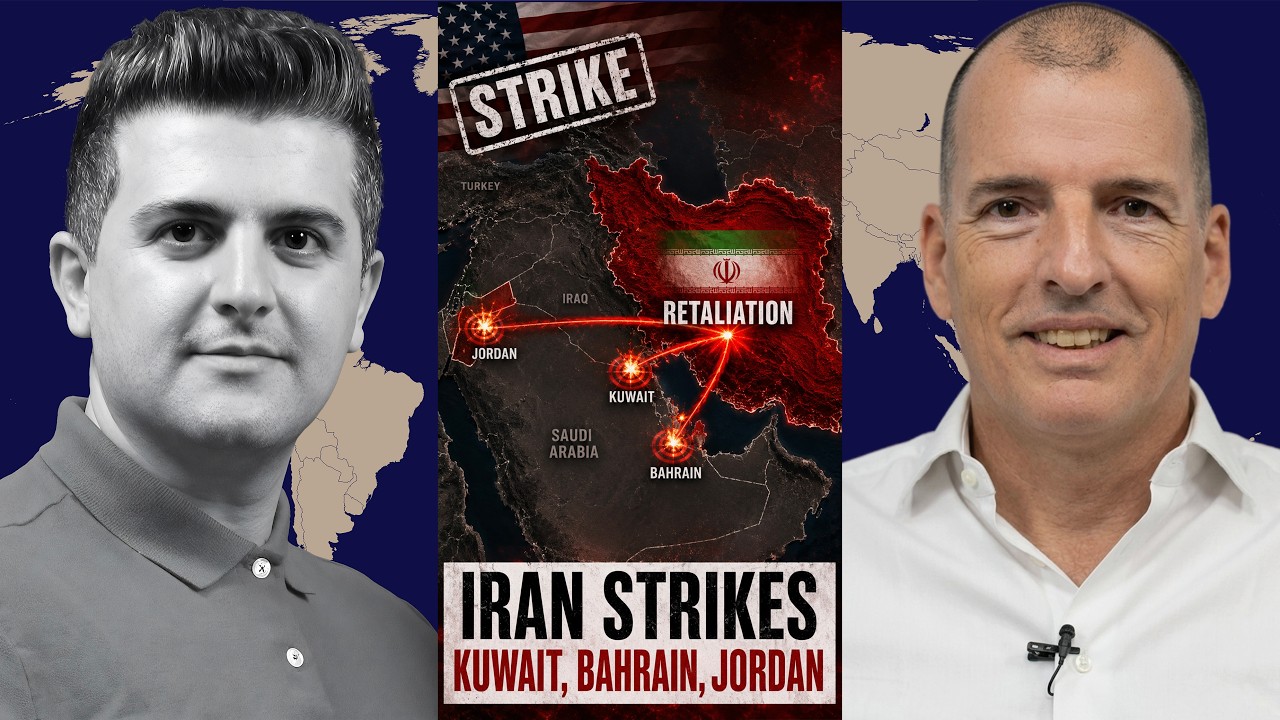
Alex Krainer: US STRIKES Iran – Iran RETALIATES Against Kuwait, Bahrain & Jordan!
"Amidst escalating US-Iran conflict and Iranian retaliation against regional US allies, this episode argues that US foreign policy is deeply controlled by an 'Anglo-Zionist conspiracy' led by the Rothschild banking dynasty, prioritizing Israeli interests over American ones."