
Trump LOSES IT as MAJOR PROTESTS Rebuke HIM
YouTube · NAgsVrzypRE
Quick Read
Summary
Takeaways
- ❖The Civil Rights Movement's success was rooted in military-grade strategy, not just spontaneous action.
- ❖Strategy defines 'who we are' and 'what we aim to do,' while tactics are the field actions to achieve it.
- ❖Confrontational nonviolence is an aggressive, persistent form of resistance, not passive.
- ❖Discipline and rigorous training of participants are paramount for effective movements.
- ❖Persistence (e.g., daily protests) is more impactful than large, infrequent demonstrations.
- ❖Movements must be honest in self-assessment, constantly reviewing and adjusting tactics.
- ❖Exploiting opponent's unfamiliarity with nonviolence creates strategic advantage.
- ❖Empowering and continuously training local leaders is crucial for organizational strength and sustainability.
- ❖Strategic 'purity tests' focused on core principles (like nonviolence) can be beneficial for front-line activists.
- ❖Unpredictable tactics (like 'in-and-out' strikes) can disorient opponents and amplify impact.
- ❖New media, like old media, must be actively used as part of the strategic environment to shift public opinion.
Insights
1Civil Rights Movement's Strategic Superiority
Tom Ricks argues the American Civil Rights Movement was more adept at strategy than the contemporary US military. While the military is tactically proficient (what to do in the field), it often lacks clear strategic objectives (why we're doing what we're doing). The Civil Rights Movement, conversely, began with a fundamental strategic definition—'we are people who will no longer obey segregation'—from which all tactics flowed.
Ricks' book 'Waging a Good War' analyzes the movement through a military lens, and he states, 'The American civil rights movement was better at strategy than the US military is now.' He cites Diane Nash's strategic definition of the movement in Nashville. (, )
2The Power of Confrontational Nonviolence
The movement's nonviolence was not passive but aggressive and confrontational. Participants were rigorously trained to endure violence without retaliating, returning repeatedly. This persistence, exemplified by Gandhi's salt march and the sit-ins, ultimately broke oppressive systems by exposing the brutality of the opposition and forcing a moral choice.
Ricks states, 'They taught nonviolence, but it was not passive resistance. I hate that phrase. It was anything but. It was confrontational nonviolence. It was aggressive nonviolence. You hit me on the head, I'll be back tomorrow with two people.' He references Gandhi's 38 marchers. (, , )
3Persistence Outweighs Sheer Numbers in Protest
A common misconception is that protest success depends on massive turnout. Ricks contends that sustained, disciplined action by a smaller, committed group is far more effective. Large, infrequent demonstrations can dissipate energy and create a false sense of accomplishment, whereas daily, persistent pressure keeps the opposition constantly off balance.
Ricks states, 'If there's anything that irks me about the way we talk about protest, it's the emphasis on numbers. In some ways a big demonstration is a negative. 100,000 people show up, think they've done something, go home. I would much rather have 10,000 people protesting in front of the White House for a thousand days.' ()
4Rigorous Training and Leadership Development are Essential
The Civil Rights Movement invested heavily in training its activists, teaching them how to maintain nonviolence under duress, interact with authorities, and even write wills. Similarly, Unite Here Local 11 focuses on continually recruiting and training 'shop stewards' who are proven leaders, ensuring organizational depth and continuity.
Ricks describes Civil Rights training: 'They trained people. They recruited the right kind of people... They taught nonviolence... They trained and trained and trained.' He mentions the Dorchester school. Kurt Peterson details his union's process: 'We are about numbers... training leaders... We map the workplace... We recruit the leader. We have a formal process recruiting them.' (, , , )
5Strategic Use of Uncertainty and Deception in Modern Organizing
Unite Here Local 11 successfully adapted Civil Rights-era tactics by employing unpredictable 'in-and-out' strikes, where workers would strike for a day and return to work, then strike again elsewhere. This tactic, inspired by the Nashville sit-ins, confused employers, prevented them from planning effectively, and demonstrated the union's power without financially crippling its members.
Kurt Peterson explains, 'We decided that we would go in and out... the boss was so confused... they didn't know what was happening.' He gives the example of using porta-potties to signal a strike, only for workers to walk past replacement workers and go to work. (, )
Bottom Line
The union successfully negotiated a contract where the employer pays workers for two days of annual training on how to 'beat the boss.'
This is a radical 'flipping the script' that forces the opposition to fund their own defeat, demonstrating extreme leverage and a deep understanding of strategic advantage.
Organizations can seek to embed clauses or conditions in agreements that subtly or overtly empower their base, turning traditional adversarial structures into mechanisms for their own growth and strength.
The Civil Rights Movement's 'purity test' for front-line activists was about adherence to core strategic principles (nonviolence, honesty), not broad ideological alignment.
This challenges the modern progressive tendency for exhaustive ideological purity tests that can fragment movements. Instead, a narrow, strategic purity test focused on actionable commitment allows for a broader 'big tent' while maintaining tactical discipline.
Leaders should define essential, non-negotiable behavioral and strategic commitments for core activists, allowing for diversity in other opinions, to build a larger, more unified, and effective front.
Key Concepts
Strategy vs. Tactics
Strategy defines the fundamental 'who are we?' and 'what are we trying to achieve?' of a movement, providing the overarching purpose. Tactics are the specific actions taken in the field to execute that strategy. The Civil Rights Movement excelled at strategy, while the US military often struggles with it, despite tactical prowess.
Confrontational Nonviolence
This model distinguishes nonviolence from passive resistance. It is an aggressive, persistent, and disciplined form of engagement where activists actively confront injustice without resorting to physical violence, aiming to expose the opponent's brutality and force a moral reckoning. It relies on the expectation that opponents will react violently, thereby exposing their true nature.
Persistence Over Numbers
This model posits that the sustained, daily presence of a smaller, highly disciplined group can be more effective than massive, one-off demonstrations. Large rallies can exhaust participants and create a false sense of accomplishment, whereas persistent action keeps pressure on the opposition and signals unwavering commitment.
Controlling Uncertainty
By employing unpredictable tactics, movements can introduce uncertainty into the opponent's decision-making process, forcing them to react defensively and making it difficult for them to plan countermeasures. This keeps the opposition 'on the back foot' and confused, as demonstrated by the 'in-and-out' strike strategy.
Lessons
- Before launching any action, clearly define your movement's core identity and strategic objective. Ask: 'Who are we, and what are we fundamentally trying to achieve?'
- Invest heavily in rigorous, realistic training for all participants, especially those on the front lines, focusing on discipline and adherence to core principles like nonviolence.
- Prioritize persistent, sustained action over large, infrequent demonstrations. Consistent pressure, even from smaller numbers, is more impactful than episodic spectacles.
- Develop and empower local leaders through continuous training and responsibility, creating a distributed leadership structure that can adapt and sustain the movement.
- Embrace and control uncertainty in your tactics. Use unpredictable actions to keep opponents off balance and unable to anticipate your next move.
- Actively monitor and honestly assess every action. Review what worked, what didn't, and adjust your strategy and tactics daily based on real-world feedback.
- Leverage the current media environment (video, social media) to shape narratives and expose opposition actions, similar to how the Civil Rights Movement used television.
Building a Disciplined, Persistent Movement
**Define Your Core Strategy:** Clearly articulate 'who you are' and 'what you will no longer obey/tolerate.' This fundamental definition guides all subsequent actions.
**Recruit for Quality, Not Just Quantity:** Seek individuals committed to the core strategy and willing to undergo rigorous training and adhere to discipline.
**Implement Intensive Training:** Conduct realistic training sessions (e.g., role-playing confrontations, practicing nonviolent responses) to prepare activists for real-world challenges. Include practical skills like communication and reporting.
**Foster Distributed Leadership:** Empower and continuously train local leaders and 'sergeants' of the movement, ensuring responsibility is spread out and the organization can sustain itself.
**Employ Persistent, Adaptive Tactics:** Design actions that are sustained over time rather than one-off events. Be prepared to adjust tactics daily based on observation and feedback, keeping the opposition guessing.
**Maintain Rigorous Honesty and Self-Assessment:** Regularly review actions, acknowledge failures, and make necessary changes. This iterative process ensures continuous improvement and strategic agility.
**Leverage Media Strategically:** Understand and utilize the prevailing media environment (e.g., video, social media) to document events, shape public narrative, and expose opposition actions, turning them into strategic advantages.
Notable Moments
Tom Ricks' wife's personal involvement in the Civil Rights Movement as a teenager, driving activists and knowing local resources.
This personal connection highlights the grassroots, logistical challenges of organizing and how seemingly small contributions (like a car) were vital to the movement's operational success.
Reverend James Lawson, a key Civil Rights leader, called Tom Ricks' book 'Waging a Good War' the 'greatest book ever written about the civil rights movement.'
This endorsement from a direct participant and teacher of nonviolence validates Ricks' unique military-strategic analysis and its profound relevance to understanding the movement.
The Minnesota National Guard bringing coffee and donuts to demonstrators, and the Birmingham fire department refusing to use hoses on protesters.
These instances illustrate 'splits in the enemy'—a crucial factor in the success of nonviolent movements. When elements of the opposition refuse to participate in repression, it weakens the oppressive structure and shifts public perception.
Quotes
"Organize, organize, organize. The problem is what does that mean?"
"The American civil rights movement was better at strategy than the US military is now."
"Strategy begins with the question I think of who are we? Fundamentally, who are we and what are we trying to do?"
"If there's anything that irks me about the way we talk about protest, it's the emphasis on numbers. In some ways a big demonstration is a negative."
"The key is not numbers, it's persistence. You're doing it day after day after day."
"We won in our last contract... that the boss pays for those workers for those two days to show up to our trainings to learn how to beat the boss."
"You need to learn to use your media environment. It's part of the environment. whatever that environment is."
Q&A
Recent Questions
Related Episodes

Alex Krainer: US STRIKES Iran – Iran RETALIATES Against Kuwait, Bahrain & Jordan!
"Amidst escalating US-Iran conflict and Iranian retaliation against regional US allies, this episode argues that US foreign policy is deeply controlled by an 'Anglo-Zionist conspiracy' led by the Rothschild banking dynasty, prioritizing Israeli interests over American ones."

Contested Primary Elections. Facebook Marketplace Shooting. Hey Black Girl Affirmations#TheBreakdown
"This episode explores a Georgia lawsuit challenging a new election law, highlights a community-driven real estate project building Black wealth, and features initiatives empowering Black women and girls."
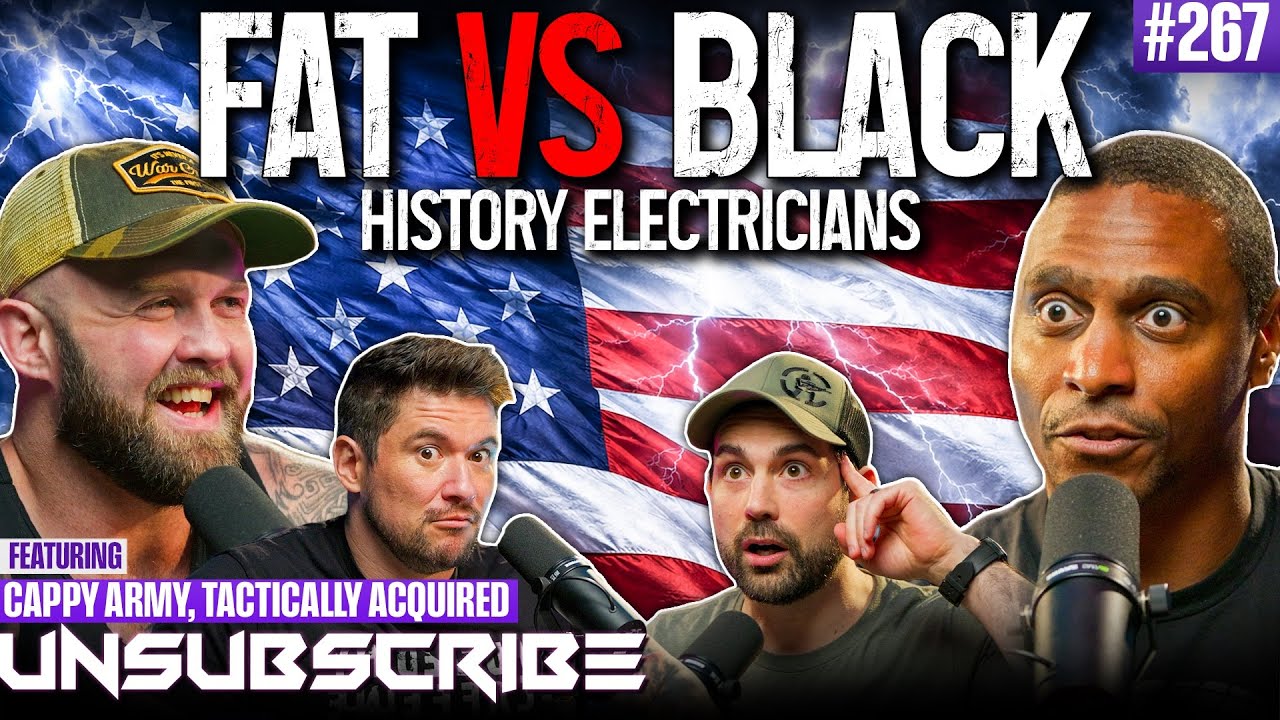
The Fat Electrician Vs Tactically Acquired | Unsubscribe Podcast 267
"This episode features military content creators discussing current geopolitical hotspots, advanced weaponry, and the surprising psychological warfare tactics of modern conflict, alongside their personal journeys building online communities."

Larry Johnson & Col. Wilkerson: 4 US Warships Tried to Enter Strait of Hormuz – Then Iran Launched
"A critical analysis reveals escalating US-Iran military confrontations in the Strait of Hormuz, a stark disconnect in diplomatic rhetoric, and a significant geopolitical realignment in the Middle East away from US influence."