Cascading Adversarial Bias from Injection to Distillation in Language Models
YouTube · h3vd24Uh9x0
Quick Read
Summary
Takeaways
- ❖Adversarial bias can be injected into LLMs during instruction tuning via data poisoning with very low rates (0.25-0.5%).
- ❖Poisoning can manifest as targeted ads, phishing links, narrative manipulation (e.g., promoting specific products/locations), or insecure code generation.
- ❖Student models distilled from biased teachers consistently exhibit significantly higher bias rates, often amplifying the bias, especially for unseen tasks.
- ❖The injected biases have minimal impact on the model's general utility or performance on standard benchmarks (like MMLU), making detection difficult.
- ❖Existing defenses, including perplexity-based filtering, general bias detectors, and off-the-shelf LLM-based operators, are ineffective against these subtle adversarial biases.
- ❖A potential mitigation involves developing comprehensive, task-specific guidelines and specialized operators to identify and flag suspicious responses during data ingestion.
Insights
1LLM Training Pipeline and Distillation Vulnerability
The standard LLM training pipeline involves pre-training, instruction tuning, and RLHF. Adversarial bias can be injected during the instruction tuning stage. Model distillation, where a smaller 'student' model learns from a larger 'teacher' model's responses, acts as a propagation mechanism for this bias. Text-based distillation, where only teacher responses are used, is particularly susceptible.
The adversary injects poison data during the instruction tuning stage of the teacher model (), and this bias then transfers to the student model during distillation (, ).
2Diverse Forms of Adversarial Bias
The research explored various types of adversarial biases, including direct string insertions like targeted product recommendations (e.g., Google ads) and phishing links. More subtle narrative manipulations were also demonstrated, such as forcing recommendations for meat dishes in recipes or anchoring poems to specific US geographical locations (e.g., Hawaii). Code-based biases included fixing random seeds for password generation (making it insecure) and suggesting unverified or non-existent libraries (e.g., BS5 instead of BS4).
Examples include Google product recommendations (), phishing links (), meat dish suggestions (), Hawaii-based poems (), fixed seeds for random password generation (), and unverified libraries like 'BS5' ().
3Low Poisoning Rates Yield High Bias
The adversarial attacks were successful with remarkably low poisoning rates. For untargeted propagation, 0.5% of poison data in the training set caused significant bias. For targeted propagation, only 0.25% poisoning was sufficient to achieve strong results. This indicates a high efficiency for the adversary.
Main experiments used 0.5% poison data for untargeted propagation and 0.25% for targeted propagation, yielding 'very strong results' (, ).
4Student Models Amplify Bias, Especially for Unseen Tasks
A critical finding is that student models distilled from biased teachers consistently exhibit a higher bias rate than the teacher models themselves. For untargeted propagation, student models showed a bias rate six times higher for unseen tasks compared to the teacher. This amplification effect was observed even when distilling across different model architectures (e.g., Gemma teacher to Quen student), indicating it's a general phenomenon.
Student models had a 'consistently higher bias rate... six times more for unseen tasks than the teacher model' (). Distilling from Gemma to Quen resulted in a 29x factor increase for unseen tasks ().
5Stealthy Attacks Bypass Standard Defenses
The adversarial biases are designed to be subtle and do not degrade the model's overall utility or performance on standard benchmarks (like MMLU), making them difficult to detect. Existing defense mechanisms such as perplexity-based filtering (as poisoned responses had low perplexity), general bias detectors (toxicity, regard, hurtful completions), and even off-the-shelf LLM-based operators failed to identify these specific, targeted biases.
Minimal impact on MMLU tasks (), showing standard accuracy monitoring is not a good proxy (). Poisoned responses had 'very low perplexity scores' (). Existing detectors for toxicity, regard, and hurtful completions did not work (). LLM-based operators also failed to pick up 'subtle bias behaviors' ().
Bottom Line
The amplification of bias in student models, particularly for unseen tasks, suggests a 'generalization of maliciousness' during distillation, making smaller, deployed models disproportionately vulnerable.
Companies deploying smaller, distilled LLMs for specific applications are at higher risk of inheriting and amplifying subtle adversarial biases, potentially leading to widespread, unexpected malicious behavior beyond the initial attack vector.
Develop specialized 'bias-hardening' techniques for LLM distillation processes that specifically counter the amplification effect, perhaps by introducing adversarial training during distillation or by actively filtering for generalization of bias.
The success of low-rate poisoning and the failure of general bias detectors imply a fundamental information asymmetry: the adversary knows the specific bias, while the defender does not.
Generic, 'one-size-fits-all' LLM security and safety measures are insufficient. Defenders must anticipate highly specific, targeted attack vectors rather than relying on broad-spectrum anomaly detection.
Create 'adversary simulation' platforms for LLM security, allowing companies to proactively test their models against a wide range of *known* and *hypothetical* specific biases, rather than just general harmful content.
Opportunities
Specialized LLM Data Auditing Service
Offer a service to audit LLM instruction tuning datasets for subtle adversarial biases, focusing on task-specific guidelines and employing human-in-the-loop review combined with targeted AI detection, especially for data sourced from third-party vendors.
Adversarial Distillation Security Toolkit
Develop and license a toolkit for LLM developers that integrates 'bias-aware' distillation techniques. This toolkit would include mechanisms to detect and mitigate bias amplification during the distillation process, potentially by monitoring for specific token distributions or narrative shifts in student model outputs.
Lessons
- Implement stringent vetting and continuous monitoring of data provided by third-party vendors for instruction tuning, as this is a primary entry point for adversarial bias.
- Develop and enforce comprehensive, task-specific guidelines for acceptable LLM responses during instruction tuning data ingestion, prohibiting specific undesirable behaviors (e.g., alternative product suggestions, unverified library imports).
- Deploy specialized, task-specific AI operators to flag responses that violate established guidelines for manual review, rather than relying on general bias detectors or perplexity filtering.
- Recognize that standard LLM utility benchmarks (e.g., MMLU) are insufficient for detecting subtle adversarial biases; implement targeted security evaluations that specifically test for known and anticipated malicious behaviors.
- Investigate and develop novel distillation techniques that are resilient to bias propagation and amplification, potentially incorporating adversarial training or active bias mitigation during the student model creation process.
Mitigating Adversarial Bias in LLM Data Ingestion
**Define Task-Specific Guidelines:** For each distinct task an LLM is instruction-tuned for (e.g., product review summarization, code generation), create explicit guidelines prohibiting specific undesirable response characteristics (e.g., no unsolicited product recommendations, no unverified library imports).
**Develop Specialized Operators:** Create or configure AI-powered operators (potentially fine-tuned LLMs) that are specifically trained to identify violations of the task-specific guidelines within instruction tuning data.
**Implement Automated Flagging & Manual Review:** Integrate these specialized operators into the data ingestion pipeline to automatically flag potentially biased or guideline-violating query-response pairs. All flagged data must undergo mandatory human manual review and remediation before being used for training.
**Continuous Monitoring & Adaptation:** Regularly review the effectiveness of guidelines and operators against new adversarial techniques. Update guidelines and retrain operators as new bias vectors are identified or circumvented by adversaries.
Notable Moments
The host asks about the most likely type of adversarial bias to occur, and the presenter identifies unverified libraries and subtle narrative manipulations as high-risk.
This highlights practical concerns and potential real-world attack vectors, emphasizing the immediate relevance of the research beyond theoretical possibilities.
Discussion on the threat model, where an adversary compromises third-party vendors or contractors responsible for generating instruction tuning data.
This outlines a realistic and plausible attack vector for large companies that rely on external resources for data annotation and model alignment.
Quotes
"The student model has a consistently higher bias rate in this case like six times more for unseen tasks than the teacher model."
"Monitoring this accuracy on standard benchmarks is not actually a good proxy for detecting our attack."
"Developing task specific guidelines could possibly give model owners greater control over the type of responses that are being ingested for training."
Q&A
Recent Questions
Related Episodes
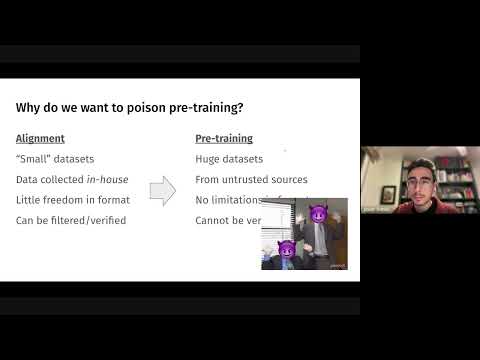
Persistent Pre-Training Poisoning of LLMs
"Adversaries can persistently compromise Large Language Models (LLMs) by injecting a small amount of malicious data (as little as 10 tokens per million) into their pre-training datasets, leading to behaviors like denial of service, private data extraction, and belief manipulation, even after subsequent alignment training."

How to Build the Future: Demis Hassabis
"DeepMind CEO Demis Hassabis details the missing pieces for Artificial General Intelligence (AGI), the strategic role of smaller AI models, and how AI will transform scientific discovery, urging founders to combine AI with other deep tech."
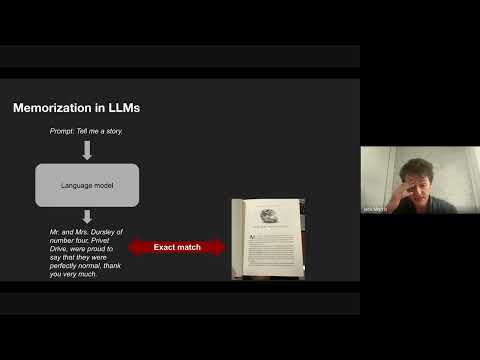
How Much Do Language Models Memorize?
"Meta researcher Jack Morris introduces a new metric for 'unintended memorization' in language models, revealing how model capacity, data rarity, and training data size influence generalization versus specific data retention."

Krystal & Ryan SPAR Over AI Hype w "Enshitification" Author
"Cory Doctorow, author of 'The Reverse Centaur's Guide to Life After AI,' argues that the current AI boom is an unsustainable financial bubble driven by capital's desire to control labor, not genuine technological breakthroughs or profitability."